Open Enrollment Alert: PPO vs. HDHP for 22% Premium Cut

Anúncios
Latest developments on Open Enrollment Alert: Choosing Between PPO and HDHP Benefits to Cut Annual Premiums by 22%, with key facts, verified sources and what readers need to monitor next in Estados Unidos, presented clearly in Inglês (Estados Unidos) (en-US).
Open Enrollment Alert: Choosing Between PPO and HDHP Benefits to Cut Annual Premiums by 22% is shaping today’s agenda with new details released by officials and industry sources. This update prioritizes what changed, why it matters and what to watch next, in a straightforward news format.
This critical period demands informed decision-making to optimize healthcare costs and coverage. Understanding the nuances between PPO and HDHP plans can significantly impact your financial well-being and access to care.
Anúncios
The goal is to equip individuals with the knowledge to select the most suitable plan, potentially leading to substantial savings. Industry experts emphasize that a careful evaluation of personal health needs and financial situations is paramount.
Understanding Open Enrollment Dynamics
Open Enrollment is the designated period each year when individuals can sign up for health insurance, change their existing plans, or opt out. This window is crucial for securing appropriate coverage for the upcoming year.
The decisions made during this time directly influence healthcare access and financial burdens. Missing the deadline can result in a lack of coverage or being locked into an unsuitable plan.
Employers and insurance providers actively communicate during this period, offering resources and guidance to help employees and consumers navigate their options effectively. This ensures a transparent process for all participants.
The Significance of PPO and HDHP Choices
The choice between a PPO (Preferred Provider Organization) and an HDHP (High-Deductible Health Plan) is central to maximizing benefits. These two plan types represent distinct approaches to healthcare financing and access.
Each plan carries unique implications for premiums, deductibles, out-of-pocket maximums, and network flexibility. Understanding these differences is key to making a financially savvy and medically appropriate decision.
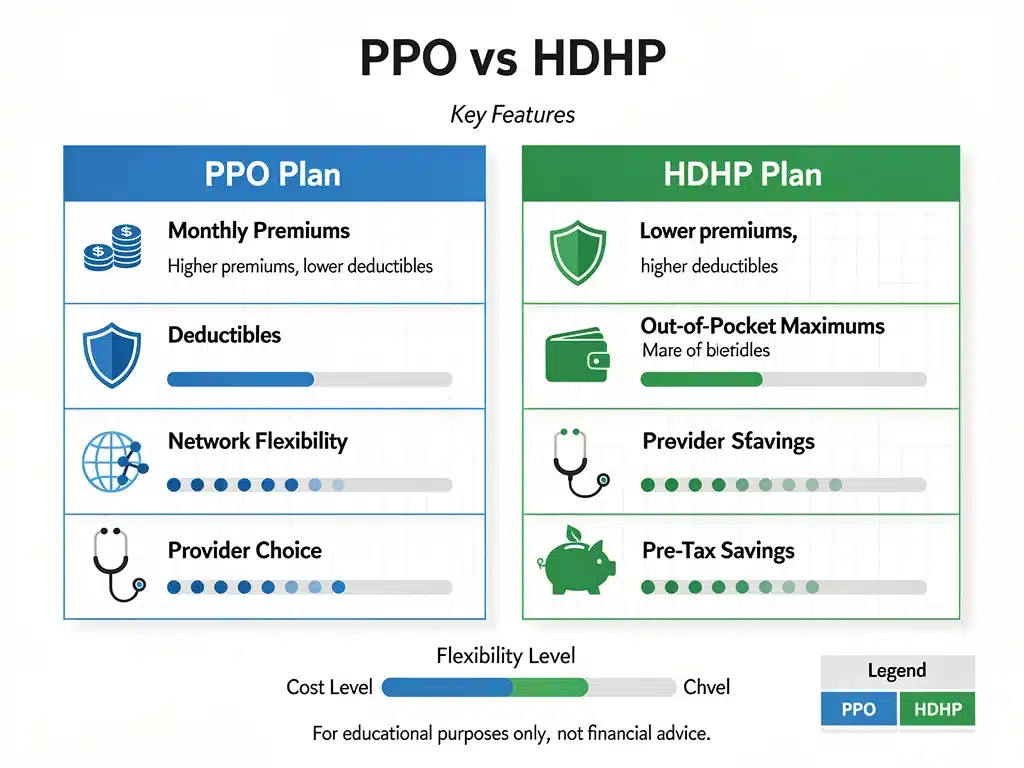
- PPO plans typically offer more flexibility in choosing providers and often have lower deductibles.
- HDHP plans usually feature lower monthly premiums but come with higher deductibles.
- The decision impacts immediate cash flow versus potential out-of-pocket costs.
Navigating these options requires a clear understanding of personal healthcare utilization and financial capacity. A well-informed choice can lead to significant annual savings, potentially up to 22% on premiums.
PPO Plans: Flexibility and Predictability
PPO plans are widely recognized for their flexibility, offering a broad network of healthcare providers. This allows members to choose their doctors and specialists without needing a referral from a primary care physician.
These plans generally come with higher monthly premiums compared to HDHPs, but often feature lower deductibles. This structure can provide more predictable out-of-pocket costs for frequent healthcare users.
For individuals who value freedom in provider choice and anticipate regular medical needs, PPO plans often present a compelling option. They offer a sense of security through broader access and more predictable expenses.
Network Access and Out-of-Pocket Costs
PPO plans typically provide extensive network access, allowing members to see both in-network and out-of-network providers. While out-of-network services may incur higher costs, the option remains available.
Anúncios
Co-payments for doctor visits and prescriptions are common with PPO plans, contributing to more predictable expenses throughout the year. This contrasts with HDHPs, where the deductible must often be met first.
- Broader network access, including specialists without referrals.
- Generally lower deductibles, leading to quicker access to insurance benefits.
- Higher monthly premiums, but potentially lower overall out-of-pocket costs for active users.
The balance between premium costs and potential out-of-pocket expenses is a critical factor when considering a PPO. For many, the added flexibility and lower upfront costs per service justify the higher monthly premium.
HDHP Plans: Lower Premiums, Higher Deductibles
High-Deductible Health Plans (HDHPs) are characterized by lower monthly premiums but significantly higher deductibles. These plans are often paired with a Health Savings Account (HSA), offering tax advantages.
HDHPs appeal to individuals who are generally healthy and anticipate minimal healthcare needs throughout the year. The lower premium provides immediate savings, offsetting the higher deductible for those who rarely use medical services.
However, it is crucial to understand that the full deductible must be met before the plan begins to cover most medical expenses. This can lead to substantial upfront costs if unexpected medical issues arise.
The Role of Health Savings Accounts (HSAs)
HSAs are tax-advantaged savings accounts available exclusively to individuals with HDHPs. Contributions to an HSA are tax-deductible, and the funds grow tax-free.
These accounts can be used to pay for qualified medical expenses, including deductibles, co-pays, and prescriptions. Unused funds roll over year to year and remain with the individual, even if they change jobs or health plans.
- Lower monthly premiums, offering immediate financial relief.
- Higher deductibles mean more out-of-pocket responsibility before coverage kicks in.
- Eligibility for an HSA provides tax benefits and a long-term savings vehicle for healthcare costs.
The combination of an HDHP and an HSA can be a powerful tool for managing healthcare costs, especially for those who can afford to cover initial medical expenses and benefit from the tax advantages of the HSA.
Strategic Considerations for Premium Reduction
Achieving a 22% reduction in annual premiums requires a strategic approach to plan selection. This involves a thorough assessment of an individual’s health status, anticipated medical needs, and financial capacity.
For healthy individuals with minimal healthcare utilization, an HDHP coupled with an HSA often presents the most significant opportunity for premium savings. The lower monthly payments directly contribute to this reduction.
Conversely, those with chronic conditions or anticipated medical procedures might find that a PPO, despite its higher premium, offers better overall value by minimizing out-of-pocket costs. The key is to project healthcare spending accurately.
Analyzing Your Healthcare Needs
Before selecting a plan, it is essential to review your past year’s medical expenses and anticipate future needs. Consider factors such as prescription medications, specialist visits, and planned procedures.
If you rarely visit the doctor and your prescriptions are minimal, an HDHP could lead to substantial savings on premiums. However, if you have ongoing medical needs, the higher deductible of an HDHP might outweigh the premium savings.
Consulting with a financial advisor or a benefits specialist can provide personalized insights based on your unique situation. They can help you model potential costs under both PPO and HDHP scenarios.
Evaluating Your Financial Situation
Your financial situation plays a significant role in determining the most suitable health plan. The ability to cover a high deductible is a critical factor when considering an HDHP.
While HDHPs offer lower premiums, it’s vital to have sufficient funds available to meet the deductible if unexpected medical expenses arise. An emergency fund specifically for healthcare can mitigate this risk.
For those with tighter budgets, the predictability of a PPO’s co-pays and lower deductible might be more appealing, even with a higher monthly premium. It’s about balancing immediate cash flow with potential future expenses.
Long-Term Financial Planning with HSAs
HSAs are not just for immediate medical expenses; they can also serve as a long-term savings and investment vehicle. The tax advantages make them an attractive option for retirement planning.
Funds in an HSA can be invested, and the earnings grow tax-free. At age 65, withdrawals for non-medical expenses are taxed as ordinary income, similar to a 401(k) or IRA, but remain tax-free for qualified medical expenses.
This dual benefit of covering current medical costs and saving for future healthcare or retirement makes HDHPs with HSAs particularly attractive for those capable of maximizing their contributions.
Navigating the Open Enrollment Process
The Open Enrollment period is time-sensitive, and understanding the process is essential to avoid missed opportunities. Most employers and state exchanges provide clear guidelines and deadlines.
It is crucial to review all available plan documents, including summaries of benefits and coverage, to compare the specifics of each option. Do not rely solely on premium costs when making your decision.
Attend informational sessions offered by your employer or insurance provider, and utilize online tools and calculators to estimate your potential out-of-pocket costs under different scenarios. This proactive approach ensures an informed choice.
Key Steps for a Successful Enrollment
Begin by assessing your current health and projected medical needs for the coming year. This forms the foundation for evaluating the suitability of PPO versus HDHP options.
Next, meticulously compare the premiums, deductibles, co-pays, and out-of-pocket maximums for each plan. Pay close attention to the provider networks to ensure your preferred doctors are covered.
- Review all plan documents thoroughly, including the Summary of Benefits and Coverage.
- Utilize online tools and calculators to estimate annual out-of-pocket costs for each plan.
- Confirm network coverage for your preferred doctors and specialists.
Finally, consider the long-term financial implications, especially if an HSA is an option. The tax benefits and investment potential of an HSA can significantly enhance your overall financial strategy.
Maximizing Savings: The 22% Premium Cut Potential
The potential to cut annual premiums by 22% is a significant incentive for careful consideration during Open Enrollment. This level of savings is often achieved by transitioning from a traditional PPO to a well-chosen HDHP.
For individuals with low healthcare utilization, the substantial difference in monthly premiums between a PPO and an HDHP can directly translate into these savings. It’s a direct benefit of selecting a plan with lower upfront costs.
However, this saving is contingent on the individual’s ability to manage the higher deductible if medical needs arise. The 22% figure is a testament to the financial leverage available through strategic plan selection.
Real-World Impact of Plan Choice
Consider a scenario where a PPO plan costs $600 per month, while an HDHP costs $470 per month. This difference of $130 per month translates to an annual saving of $1,560, which is approximately a 21.7% reduction.
This example highlights how selecting an HDHP can significantly lower your fixed healthcare expenses. The trade-off is the higher deductible, which must be weighed against your health and financial comfort level.

For many, the lower premium provides immediate financial relief, freeing up funds for other expenses or for contributing to an HSA. This strategy underscores the importance of a personalized approach to health insurance.
Long-Term Benefits and Future Planning
Beyond immediate premium savings, the choice between PPO and HDHP has long-term implications for financial health. An HDHP combined with an HSA offers unique advantages for future healthcare costs and retirement.
The ability to invest HSA funds and have them grow tax-free provides a powerful tool for accumulating wealth specifically for medical expenses in retirement. This foresight can alleviate future financial burdens.
For younger, healthier individuals, starting an HSA early allows more time for investments to compound, potentially building a substantial nest egg for future healthcare needs. This proactive planning is a cornerstone of financial well-being.
Adapting to Changing Healthcare Needs
It is important to re-evaluate your health plan choices annually during Open Enrollment. Your healthcare needs and financial situation can change over time, making a previously suitable plan less ideal.
For instance, if you anticipate a major medical event or a new chronic condition, switching from an HDHP to a PPO might be more beneficial. The flexibility of Open Enrollment allows for these critical adjustments.
Staying informed about new healthcare trends and policy changes is also vital. The landscape of health insurance is constantly evolving, and being aware of these shifts can help you make the best decisions year after year.
| Key Aspect | Description |
|---|---|
| Premium Savings | HDHPs can reduce annual premiums by up to 22% compared to PPOs. |
| Deductible Impact | PPOs have lower deductibles; HDHPs have higher deductibles to meet. |
| Network Flexibility | PPOs offer broader network access; HDHPs often have more restricted networks. |
| HSA Eligibility | Only HDHPs are eligible for tax-advantaged Health Savings Accounts. |
Frequently Asked Questions About Health Plan Choices
The primary difference lies in their premium and deductible structures. PPO plans generally have higher monthly premiums but lower deductibles and more flexible provider networks. HDHP plans, conversely, feature lower monthly premiums but come with significantly higher deductibles, often paired with eligibility for a Health Savings Account (HSA).
HDHPs inherently have lower monthly premiums due to their higher deductibles. For individuals with minimal healthcare needs, this lower fixed cost directly translates into significant annual savings. The 22% reduction is an illustrative potential saving achieved by maximizing the premium difference between a typical PPO and a cost-effective HDHP.
Individuals who are generally healthy, have low anticipated medical expenses, and can afford to cover a high deductible benefit most. The HSA component offers tax advantages for contributions, tax-free growth, and tax-free withdrawals for qualified medical expenses, making it an excellent long-term savings vehicle.
The primary downside is the high deductible, meaning you must pay a substantial amount out-of-pocket before your insurance coverage fully kicks in. This can be a financial burden if unexpected medical emergencies or significant health issues arise, requiring a solid emergency fund to mitigate the risk.
Consider your health status, anticipated medical needs (e.g., prescriptions, specialist visits), financial capacity to meet deductibles, and preferred provider networks. Reviewing past medical expenses and utilizing online cost calculators can help you project future costs under different plans, ensuring an informed decision for your health and finances.
What this means
The imperative to navigate Open Enrollment Alert: Choosing Between PPO and HDHP Benefits to Cut Annual Premiums by 22% underscores a crucial financial decision for millions. Understanding the fundamental differences and potential savings, particularly the 22% premium cut, is paramount. This period is not merely about renewing coverage but optimizing it for both health and financial well-being. Individuals must proactively assess their needs and leverage available resources to make informed choices that resonate throughout the coming year.