New Parental Leave Benefits 2026: 80% US Companies Offering

Anúncios
Parental leave benefits in the United States expanded in 2026, with 46% of employers surveyed by SHRM offering paid parental leave.
Federal law still does not provide universal paid parental leave for private-sector workers, while state programs, employer policies and an expanded federal employer tax credit continue to shape access.
Parental Leave Benefits continue to evolve in the United States as employers compete for talent and more workers expect support when welcoming a child.
Anúncios
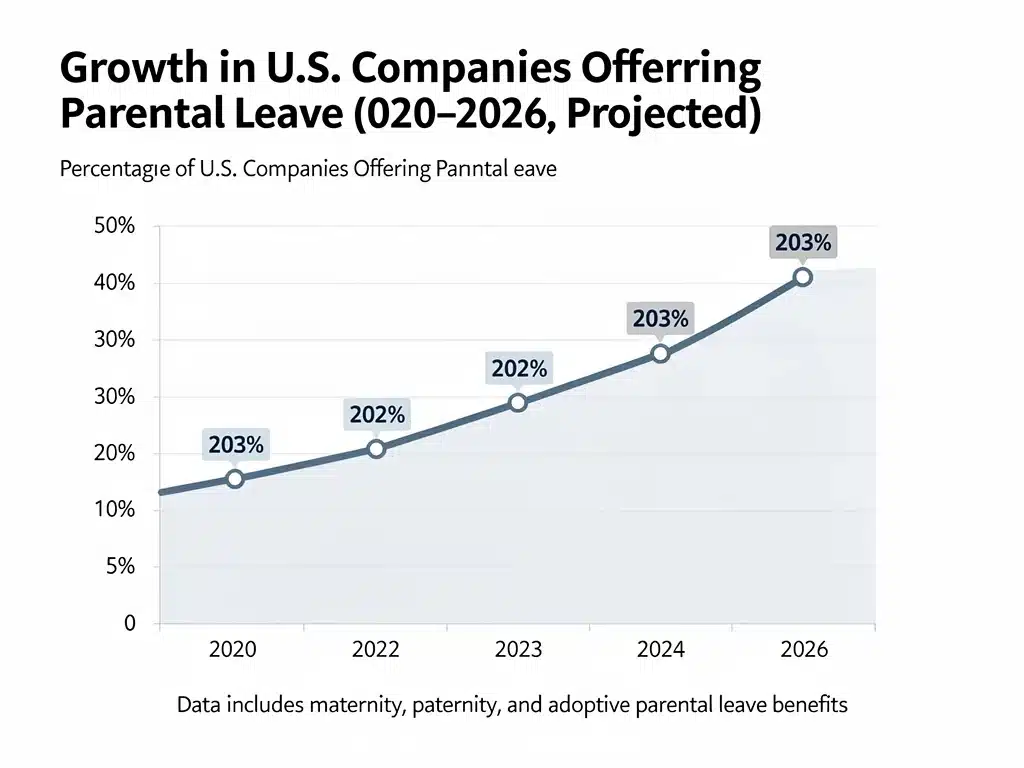
The latest evidence shows meaningful growth, but not universal coverage: SHRM’s 2026 benefits survey found that 46% of participating employers offered paid parental leave, up from 39% in 2025.
Employees therefore need to distinguish between federal job-protected leave, state paid-leave programs and benefits voluntarily provided by their own employer.
The Shifting Landscape of Parental Leave
The U.S. employee benefits landscape continues to change, particularly around leave for new parents and other family-care responsibilities.
SHRM reported one of the strongest recent increases in paid parental leave during 2026, although fewer than half of surveyed employers currently offer the benefit.
This makes parental leave an increasingly important workplace benefit while also highlighting the significant gaps that remain between employers, industries and states.
What the 2026 Data Actually Shows
According to the 2026 SHRM Employee Benefits Survey, 46% of employers provide paid parental leave, representing a seven-percentage-point increase from 2025.
Paid maternity leave beyond legal requirements rose to 44%, while paid paternity leave increased to 34% and paid family leave reached 36%.
These figures support a clear upward trend, but they do not support claims that approximately 80% of all U.S. companies now provide enhanced parental leave.
- Paid parental leave: 46% of surveyed employers.
- Paid maternity leave: 44%.
- Paid paternity leave: 34%.
- Paid family leave: 36%.
- Paid prenatal leave beyond legal requirements: 18%.
Key Drivers Behind the Expansion
Employers increasingly view paid leave as part of talent attraction, retention and workforce well-being rather than solely as a compliance issue.
Employee expectations also play a role, particularly as workers compare benefits when evaluating employers and making decisions about long-term employment.
Anúncios
State paid-leave programs and federal tax incentives can also reduce some of the financial barriers employers face when considering more generous policies.
- Competition for skilled workers.
- Growing employee expectations for family support.
- State paid family and medical leave programs.
- Federal employer tax incentives.
- Greater focus on retention and workforce participation.
Economic and Social Impact
Paid parental leave can help employees remain attached to the workforce during a major family transition instead of choosing between employment and caregiving.
For employers, better retention can reduce some costs associated with replacing and training experienced workers, although results vary by organisation and occupation.
Broader access can also make it easier for different types of parents to participate in early childcare, supporting a more balanced distribution of family responsibilities.
What Parental Leave Benefits Can Include
Parental leave is not one standardised benefit in the United States because policies vary significantly between employers and jurisdictions.
Some companies provide fully paid bonding leave, while others offer partial pay, short-term disability benefits, unpaid job-protected leave or combinations of several programs.
Employees should therefore review the actual policy applicable to them rather than assuming that the term “parental leave” guarantees a specific duration or level of compensation.
Duration and Compensation Trends
There is no federal requirement that private-sector employers provide a universal period of paid parental leave to all workers.
Employers that voluntarily offer paid leave may provide different durations and replacement rates depending on tenure, job classification, company policy and coordination with state benefits.
Rather than relying on a general claim that 12 to 16 weeks is the U.S. average, workers should verify the exact duration available under their employer and state programs.
Beyond Paid Leave: Comprehensive Support
Some employers supplement parental leave with flexible scheduling, remote-work options, childcare assistance or support for employees returning after an extended absence.
Lactation accommodations and related protections may also apply under separate federal or state requirements rather than being part of the parental leave policy itself.
These additional benefits can make the transition easier, but their availability varies substantially and should not be described as standard across U.S. employers.
- Flexible or phased return-to-work arrangements.
- Access to childcare resources or subsidies.
- Lactation facilities and related workplace support.
- Employee assistance and parenting resources.
The Federal Legal Baseline
At the federal level, the Family and Medical Leave Act remains the central job-protection law for eligible private-sector workers taking qualifying family or medical leave.
The FMLA generally provides up to 12 workweeks of unpaid, job-protected leave during a 12-month period for qualifying reasons including birth, adoption and foster placement.
It also requires continuation of group health benefits on the same terms during protected leave, but it does not generally require private employers to pay employees while they are absent.
Who Is Covered by FMLA?
FMLA applies to public agencies, schools and private employers with at least 50 employees for at least 20 workweeks in the current or previous calendar year.
Employee eligibility includes additional requirements related to length of service, hours worked and the number of employees within the relevant geographic area.
Because both employer coverage and employee eligibility matter, working for a large company alone does not automatically mean every worker qualifies for FMLA leave.
Birth, Adoption and Foster Placement
Eligible employees can use FMLA leave after the birth of a child and for bonding during the 12-month period following birth.
The law also covers eligible employees when a child is placed with them for adoption or foster care and allows bonding leave during the relevant 12-month period.
The Department of Labor states that parents have the same FMLA bonding rights regardless of sex, which is important when comparing leave policies for mothers and fathers.
FMLA Is Generally Unpaid
FMLA itself guarantees unpaid leave, although employees may sometimes use employer-provided paid vacation, sick leave or family leave concurrently when applicable rules allow it.
Employers may also require substitution of certain paid leave under permitted circumstances, meaning paid benefits and FMLA protection can overlap.
This distinction is important because a worker can have job protection under federal law without necessarily receiving wage replacement during the entire absence.
Paid Leave for Federal Employees
Covered federal employees operate under a different framework from most private-sector workers because federal law provides a specific paid parental leave entitlement.
The Federal Employee Paid Leave Act allows eligible covered federal employees to substitute paid parental leave for qualifying FMLA leave following a birth, adoption or foster placement.
This benefit can provide up to 12 workweeks of paid parental leave during the 12-month period following the qualifying event.
Eligibility and Work Obligation
A federal employee generally must meet applicable FMLA eligibility requirements to use paid parental leave under the Federal Employee Paid Leave Act.
The paid leave must be connected to a qualifying birth or placement and used during the applicable 12-month period.
Federal employees using the benefit generally must also agree in writing to return to work for the employing agency for at least 12 weeks after the paid leave concludes.
State Paid Family and Medical Leave Programs
State law can significantly change the benefits available to a worker because several states operate paid family and medical leave insurance programs.
The U.S. Department of Labor currently identifies 13 states and the District of Columbia as having laws establishing paid family and medical leave programs for eligible workers.
The programs differ in eligibility, funding, benefit amount, duration and job-protection rules, making location an essential part of any parental-leave analysis.
Examples of State Programs
California, New York, New Jersey and Massachusetts are among the jurisdictions that operate established paid family or medical leave programs.
For example, Massachusetts PFML can provide temporary income replacement for qualifying workers welcoming a new child or addressing other covered family and medical needs.
Employees should consult their state labour or leave agency because benefit formulas and requirements change and can differ substantially from federal FMLA protections.
State Benefits and Employer Leave Can Interact
State wage-replacement benefits and employer-provided parental leave are not always separate programs that simply stack on top of one another.
Employers may coordinate their own paid-leave benefits with state programs, short-term disability coverage or other sources of wage replacement.
The amount ultimately received by an employee therefore depends on the employer policy, state rules and how those different benefits are coordinated.
A Major 2026 Change: The Federal Employer Tax Credit
One of the most important developments in 2026 concerns the federal tax credit available to qualifying employers that provide paid family and medical leave.
Changes enacted in 2025 made the Section 45S employer credit permanent and expanded how eligible businesses can claim the benefit beginning in 2026.
The policy does not create a direct paid-leave entitlement for workers, but it can provide a stronger financial incentive for employers to offer qualifying paid leave.
How the Credit Works
Eligible employers can receive a general business tax credit generally ranging from 12.5% to 25% of qualifying wages paid during eligible family and medical leave.
The credit can apply for up to 12 weeks of qualifying family and medical leave per employee during a taxable year under applicable requirements.
Beginning in 2026, employers can also elect a premium-based method when qualifying paid family and medical leave is provided through eligible insurance arrangements.
Expanded Eligibility in 2026
The updated rules allow qualifying employers to include certain employees after six months of service instead of the previous one-year threshold.
They also expand eligibility to qualifying employees customarily working at least 20 hours per week under the applicable rules.
Leave required by state or local mandates can now help an employer meet eligibility conditions for the credit, although mandated leave is not itself included when calculating the credit amount.
Industry-Specific Adoption and Variation
Paid parental leave remains unevenly distributed across the U.S. workforce, meaning access can vary considerably by industry, occupation, employer size and location.
Large professional-services, technology and finance employers often receive attention for generous policies, but that should not be interpreted as evidence that every firm in those sectors offers similar benefits.
Employers in sectors requiring continuous in-person staffing may face different operational challenges when designing extended paid-leave programs.
Large Employers and Competitive Benefits
Large companies may have greater financial and staffing capacity to provide paid parental leave while temporarily redistributing an employee’s responsibilities.
Some also use family-related benefits to distinguish themselves in competitive labour markets and strengthen their overall employee-value proposition.
Even among large employers, however, eligibility, duration and pay replacement can differ substantially, so employees should compare actual written policies rather than sector averages.
Challenges and Opportunities for Smaller Businesses
Small employers can face more significant staffing challenges when one employee is absent for several weeks because there may be fewer people available to redistribute responsibilities.
Cost can also be a concern, particularly when the business continues paying wages while also funding temporary staffing or overtime.
The permanent and expanded Section 45S credit and state paid-leave insurance programs may make it easier for some small employers to provide benefits without bearing the entire cost alone.
Impact on Employee Retention and Satisfaction
Family-supportive leave can influence an employee’s decision to remain with an employer, particularly after birth, adoption or another major caregiving transition.
Research and employer surveys consistently identify paid leave as an increasingly important component of workforce retention and participation.
The strength of the effect varies by occupation and employer, so paid leave should be viewed as one retention tool rather than a guaranteed solution to turnover.
Supporting Return to Work
Employees who can take meaningful leave may have more time to manage early childcare responsibilities before returning to their normal work schedule.
A predictable return process can also help managers plan staffing and allow employees to understand what will happen to responsibilities during their absence.
Phased schedules or temporary flexibility can further support the transition when employers choose to offer those arrangements.
Reducing Turnover Costs
Replacing an experienced employee can involve recruitment, onboarding, training and temporary losses in productivity while the new worker becomes established.
Retaining employees after parental leave can therefore avoid some of these costs and preserve knowledge that has already been developed inside the organisation.
The financial benefit depends on the role and company, making precise universal claims about savings inappropriate without employer-specific data.
- Potentially lower recruitment expenses.
- Reduced onboarding and training requirements.
- Retention of institutional knowledge.
- Greater continuity within established teams.
Best Practices for Implementing Parental Leave
A strong parental leave policy needs to be clear enough that employees can understand eligibility, duration, pay and the process for requesting leave before a family event occurs.
Employers also need to coordinate the policy with FMLA, state leave programs, disability benefits and any other overlapping legal obligations.
Good administration matters because even a generous policy can cause confusion if employees do not understand how different benefits interact.
Crafting a Clear and Inclusive Policy
Written policies should clearly identify who is eligible, how much leave is available, whether it is paid and how wage replacement is calculated.
Employers should also explain how leave applies to birth, adoption and foster placement and whether different categories of caregivers receive different benefits.
Using inclusive language can make policies easier to understand across different family structures while reducing unnecessary distinctions that may discourage eligible employees from using leave.
- Clearly defined eligibility rules.
- Specific duration and compensation information.
- Coverage for relevant birth, adoption and foster-care circumstances.
- Explanation of coordination with FMLA and state benefits.
- Clear instructions for applications and questions.
Supporting Employees Before, During and After Leave
Before leave begins, employees and managers can establish a practical handover plan so essential responsibilities are covered during the absence.
Communication during leave should respect the employee’s time away rather than creating an expectation that the employee continue performing normal duties.
When the worker returns, appropriate flexibility and a clear reintegration plan can reduce confusion and help both the employee and team transition smoothly.
The Future Outlook for Parental Leave in the U.S.
The 2026 data supports continued growth in employer-provided paid parental leave, but the United States remains far from universal private-sector coverage.
State paid family and medical leave programs are expanding the number of workers with access to wage replacement even where employer benefits are limited.
The permanent federal employer tax credit may also influence future benefit design by reducing some of the cost associated with offering qualifying leave.
Continued Growth, but Not Yet Standardised
Paid parental leave rose substantially between 2025 and 2026 according to SHRM, making continued growth plausible if employer interest remains strong.
However, the current 46% figure means access is still far from universal and workers cannot assume that a new employer automatically provides paid bonding leave.
The lack of one national private-sector paid parental leave entitlement also means substantial differences will remain between states and companies in the near term.
The Role of Employee Expectations
Employee preferences can influence benefit design when employers compete for workers with similar salaries, job responsibilities and career opportunities.
Parental leave may be particularly relevant to workers who expect to start or expand families and want greater financial predictability during time away from work.
Employers will therefore continue balancing benefit costs with recruitment, retention and broader workforce strategies when deciding whether to expand their policies.
What Employers Should Monitor
Employers should monitor state paid-leave legislation because the number and structure of mandatory programs continue to evolve across the country.
They should also follow IRS guidance regarding the expanded permanent Section 45S tax credit and forthcoming regulations affecting its implementation.
Finally, regular benchmarking can help companies understand whether their policies remain competitive relative to employers of similar size, industry and location.
| Key Point | 2026 Status |
|---|---|
| Paid Parental Leave | 46% of employers in SHRM’s 2026 survey offered paid parental leave. |
| Federal FMLA | Eligible workers can receive up to 12 weeks of unpaid, job-protected leave for qualifying reasons. |
| State Programs | 13 states and Washington, D.C. have laws creating paid family and medical leave programs. |
| Federal Employees | Eligible covered federal employees may receive up to 12 weeks of paid parental leave. |
| Employer Tax Credit | Section 45S is permanent and expanded beginning in 2026 for qualifying employers. |
Frequently Asked Questions About Parental Leave Benefits
No reliable 2026 data supports that claim. SHRM’s survey of 5,472 organisations found that 46% of employers offer paid parental leave, up from 39% in 2025.
No. The federal FMLA generally provides eligible workers with unpaid, job-protected leave. Paid benefits may come from an employer, a state program or another applicable source.
Eligible employees can generally receive up to 12 workweeks of FMLA leave in a 12-month period for qualifying reasons including birth, adoption and foster placement.
Eligible covered federal employees can receive up to 12 workweeks of paid parental leave following a qualifying birth, adoption or foster placement.
Yes. The Department of Labor currently identifies 13 states and the District of Columbia as having laws creating paid family and medical leave programs for eligible workers.
The federal Section 45S paid family and medical leave employer tax credit was made permanent and expanded, including new eligibility provisions and a premium-based calculation option.
Sometimes, but the coordination rules vary. Employer policies may offset, supplement or run concurrently with state wage-replacement and job-protection programs.
Looking Ahead
The parental leave benefits landscape in 2026 shows real expansion, but the evidence points to gradual growth rather than universal employer coverage.
The most important figure to follow is currently **46% of employers offering paid parental leave in the SHRM survey**, alongside continued development of state paid-leave programs.
Workers should compare federal protections, state benefits and their employer’s written policy, while businesses should monitor new state requirements and implementation of the expanded federal tax credit.